
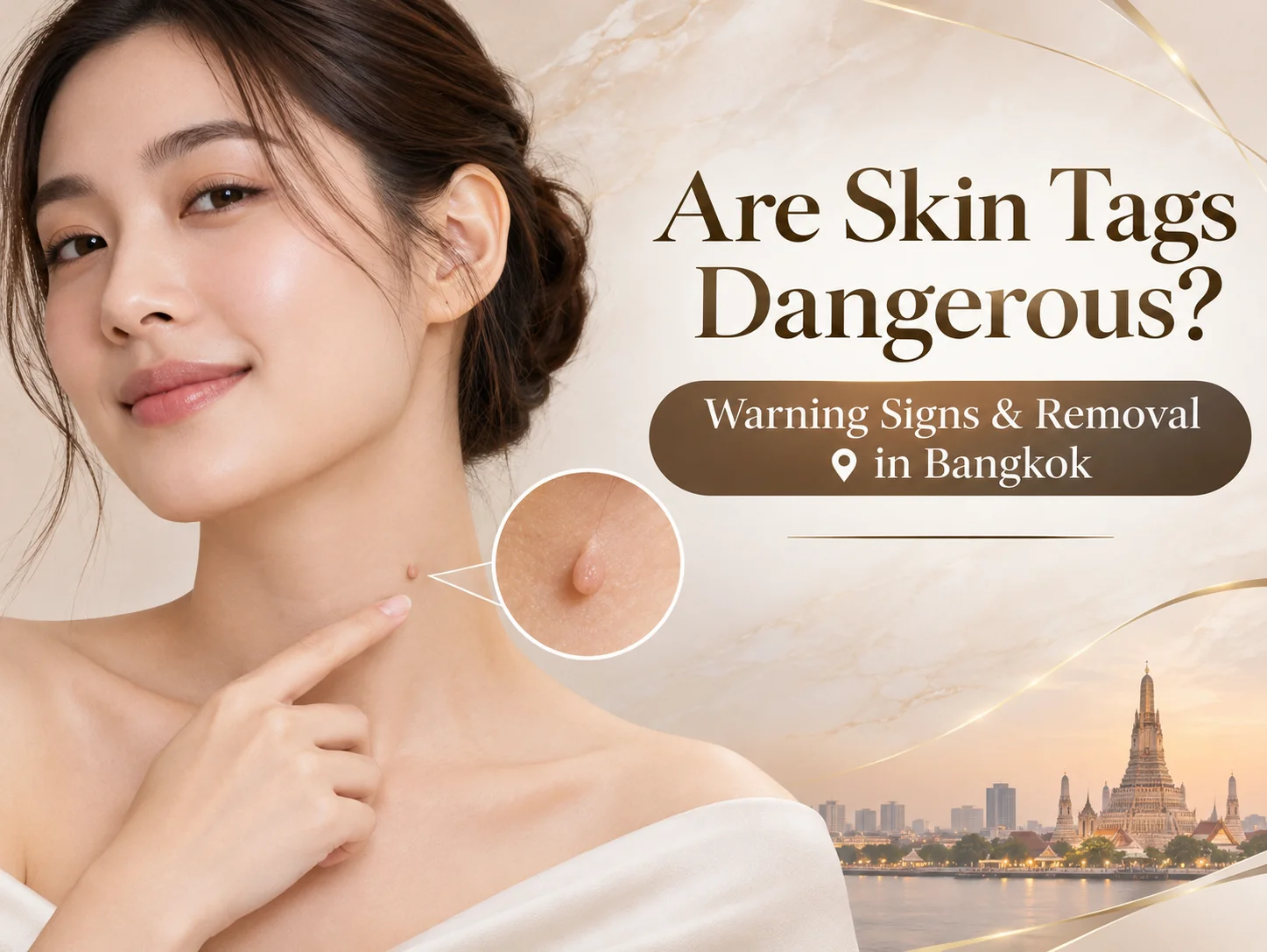
🔍 Quick Answer: Are skin tags dangerous? In most cases, no. Skin tags are small, soft, harmless growths that commonly appear on the neck, armpits, and eyelids. They are not cancerous and not contagious. However, a growth that changes quickly, bleeds without injury, or changes color should be checked by a doctor, because it may be something other than a skin tag. If a skin tag bothers you, a doctor can remove it quickly with CO2 laser.
If you have noticed a small, soft bump hanging from your neck or underarm, you are not alone. Skin tags are a very common reason people visit an aesthetic or skin clinic, and the first question is almost always the same: are skin tags dangerous, and do they need to come off?
This guide explains what skin tags are, why they form, which signs deserve a doctor’s attention, and what your removal options are if you live in or are visiting Bangkok.
What Are Skin Tags?
Skin tags, known medically as acrochordons, are small growths of soft skin that usually hang from the body on a thin stalk. They are made of loose collagen fibers and small blood vessels covered by a layer of skin. Most are flesh-colored or slightly darker than the surrounding skin, and they range from the size of a grain of rice to a few millimeters across, occasionally larger.
They tend to appear where skin rubs against skin or clothing. Common locations include the neck, armpits, eyelids, under the breasts, the groin, and folds of the stomach. You may notice just one, or several clustered in the same area, such as a row along the neckline.
Skin tags are very common in adults, and they become more frequent with age. Many people first notice them in their 30s or 40s.
Are Skin Tags Dangerous?
For the vast majority of people, the answer is reassuring. Skin tags are benign, meaning they are not cancer. They do not spread to other parts of the body, and you cannot catch them from another person or pass them on through touch.
In practical terms, the problems skin tags cause are usually about comfort and appearance rather than health. A skin tag on the neck may catch on a necklace or shirt collar. One under the arm may rub against a bra strap or become irritated when you shave. If a skin tag gets twisted or snagged, it can become red, sore, or bleed a little.
There is one important caveat. Not every small growth is a skin tag. Moles, warts, seborrheic keratoses, and, rarely, skin cancers can sometimes look similar at first glance. So the more useful question is not only “are skin tags dangerous?” but also “am I sure this is a skin tag?” That is where a doctor’s examination helps.
Why Do Skin Tags Form?
Doctors do not know one single cause of skin tags, but several factors are known to make them more likely:
- Friction: Areas where skin rubs against skin or clothing are the usual locations.
- Age: Skin tags become more common as we get older.
- Body weight: People with a higher body weight tend to have more skin folds and more friction, and skin tags are more common in this group.
- Hormonal changes: Some women notice new skin tags during pregnancy.
- Genetics: Skin tags often run in families.
- Blood sugar: Having many skin tags has been linked in some people with insulin resistance and type 2 diabetes. If a large number appear over a short period, it is reasonable to mention this to your doctor, who may suggest a blood sugar check.
Bangkok’s heat and humidity can add to the problem in an indirect way. Sweating and close-fitting clothes increase friction in skin folds, which can make existing skin tags more irritated.
When Are Skin Tags Dangerous? Warning Signs to Watch For
A typical skin tag is soft, smooth, painless, and stays roughly the same size for a long time. See a doctor if a growth shows any of the following:
- It grows quickly over weeks or a few months.
- It bleeds without being caught, scratched, or injured.
- It changes color, becomes very dark, or has several colors in one spot.
- It has an irregular shape or uneven edges.
- It becomes painful, swollen, or inflamed.
- It looks different from your other skin tags.
- Many new growths appear in a short time.
None of these signs automatically means something serious, but they are good reasons to have the growth examined rather than assuming it is a harmless skin tag.
Skin Tags vs. Moles vs. Warts vs. Seborrheic Keratoses
These growths can look alike, but they are different conditions and are handled differently.
- Skin tags: Soft, flesh-colored or slightly darker, often hanging on a thin stalk. Not contagious.
- Moles: Clusters of pigment cells, usually brown or black, which can be flat or raised. Most are harmless, but a mole that changes in size, shape, or color should always be checked.
- Warts: Rough, firm bumps caused by a viral infection. Unlike skin tags, warts can spread to other areas or to other people.
- Seborrheic keratoses: Brown or black growths with a waxy, “stuck-on” look, common with age. Harmless, but sometimes mistaken for moles.
Because the treatment and the level of concern differ, a doctor should confirm what a growth is before it is removed. This is especially important for anything dark or changing.
Should You Remove a Skin Tag?
Removing a skin tag is usually a personal choice rather than a medical necessity. People often decide to have them removed when:
- They catch on jewelry, collars, or bra straps.
- They become irritated or bleed from rubbing or shaving.
- They are in a visible place, such as the neck, face, or eyelids, and affect confidence.
- New ones keep appearing in the same area.
If a skin tag does not bother you and has not changed, leaving it alone is also a reasonable choice.
Why You Should Not Remove Skin Tags at Home
Online videos often show people cutting skin tags off, tying them with thread, or using freezing kits and removal creams. These methods may seem convenient, but they come with real risks:
- Bleeding: Skin tags have their own small blood supply, so cutting one can bleed more than expected.
- Infection: Home tools are not sterile, and an open wound in a sweaty skin fold can become infected.
- Scarring and pigmentation: Uneven removal or chemical burns can leave marks, especially on darker skin.
- Missing something important: Removing a growth at home means no one has checked whether it was really a skin tag.
Having it removed by a doctor is quick and allows the growth to be examined first.
Skin Tag Removal Options
Doctors use several methods to remove skin tags. The choice depends on the size, number, and location of the growths.
- CO2 laser: A focused laser beam removes the tissue precisely and seals small blood vessels at the same time, which keeps bleeding minimal. It is well suited to small and medium skin tags, including those on the face and neck.
- Electrocautery: An electric current is used to burn off the skin tag. It is effective, but it may leave a larger mark around the treated area.
- Snip excision: The skin tag is cut off with sterile surgical scissors. This is often used for larger skin tags and may need a small dressing.
- Cryotherapy: The skin tag is frozen with liquid nitrogen and falls off later. It can be less precise for small growths and may lighten the skin in darker skin tones.
Removing Skin Tags at La Grace Clinic
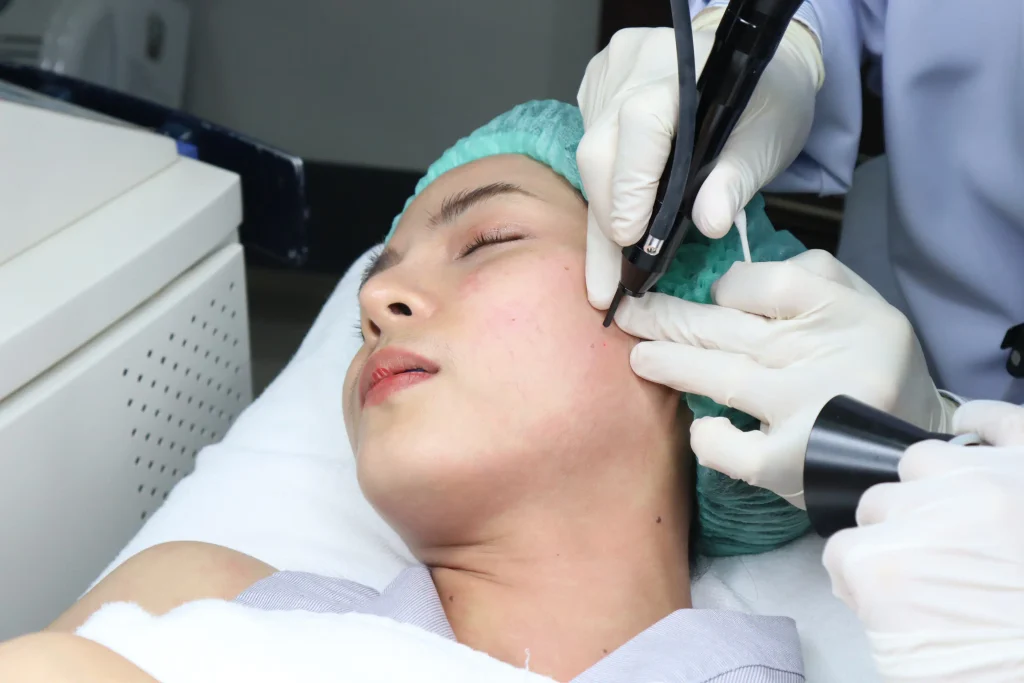
At La Grace Clinic, skin tags are removed with CO2 laser by a licensed doctor, available at our 8 branches across Bangkok. Every treatment starts with an examination to confirm the growth is a skin tag before removal.
What to expect:
- Assessment: Your doctor examines the growths and confirms which ones are suitable for laser removal.
- Numbing: A numbing cream is applied, so most people feel only mild warmth during treatment.
- Removal: The doctor removes each skin tag with the laser. The visit typically takes about 30–45 minutes, including preparation.
- Aftercare advice: You go home the same day with instructions for caring for the treated spots.
The cost for small skin tags is 300 THB per point. Your doctor will confirm the total after assessing the size and number of growths. See details in Laser CO2 Treatment for Skin Tags, Moles, and Freckles, or learn more about the procedure in CO2 Laser for Skin Tag Removal in Bangkok – Precise & Low-Risk.
Visiting Bangkok for a short time? Skin tag removal is usually completed in one visit, which makes it practical for travelers. Plan around healing, though: the treated spots should be kept out of pools and the sea until they have healed, so it is better to schedule removal after a beach trip rather than before.
Aftercare, Healing & Possible Side Effects
After CO2 laser removal, each treated spot forms a small scab. In general, the scab falls off on its own within about 7–10 days, and the skin underneath continues to settle over the following weeks.
Aftercare tips:
- Keep the area clean and gently pat it dry.
- Apply any ointment your doctor recommends.
- Do not pick or scratch the scab. Let it fall off naturally.
- Avoid swimming pools, the sea, saunas, and steam rooms until the area has healed.
- Protect the area from the sun with clothing or sunscreen once it has healed. Bangkok’s strong sun can darken healing skin.
- Where possible, avoid tight collars, necklaces, or straps rubbing on the treated spots.
Possible side effects:
- Mild redness or tenderness for a few days
- A pink or slightly darker mark after the scab falls off, which usually fades over weeks to months
- Post-inflammatory hyperpigmentation, more likely in darker skin tones or with sun exposure during healing
- Rarely, infection or a small scar
Contact the clinic if you notice increasing pain, swelling, pus, or bleeding that does not stop with gentle pressure.
FAQ: Are Skin Tags Dangerous?
A: Skin tags are benign and are very unlikely to become cancerous. However, a growth that looks like a skin tag but changes in size, color, or shape should be checked, because it may be a different type of lesion.
A: No. Skin tags cannot be passed from person to person. Warts, which can look similar, are contagious, which is one reason a correct diagnosis matters.
A: A skin tag that has been removed does not usually grow back in the same spot. However, new skin tags can form in other areas over time, especially where there is friction.
A: With numbing cream, most people feel only mild warmth or a slight sting. Small skin tags are removed quickly.
A: Occasionally a skin tag twists on its stalk, loses its blood supply, and falls off. This can be uncomfortable and may bleed or become inflamed, so it is better to have a bothersome skin tag removed by a doctor.
A: Skin tags that appear during pregnancy are usually harmless and are linked to hormonal changes. Some shrink after pregnancy. Removal is generally postponed until after pregnancy unless your doctor advises otherwise.
So, Are Skin Tags Dangerous? The Bottom Line
For most people, skin tags are harmless growths that cause more irritation than risk. The key is to be sure that what you have is truly a skin tag. If a growth is changing, bleeding, or looks different from the rest, have it checked. And if a skin tag is simply in the way, removal by a doctor is quick, with a short and simple healing period.
Related Reading
- CO2 Laser for Skin Tag Removal in Bangkok – Precise & Low-Risk
- Laser CO2 Treatment for Skin Tags, Moles, and Freckles
- Melasma Treatment in Bangkok: Types, Options & Aftercare
- Sensitive Skin: Causes & How to Restore Your Skin Barrier
Book a Free Consultation
Not sure whether a growth is a skin tag, a mole, or something else? Book a free consultation with our doctors at any of our 8 branches in Bangkok. You can also send us a photo via WhatsApp or Line for an initial consultation.
📲 WhatsApp: +66 90 665 9963
Line: @lagraceclinic
Phone: 087 494 4000 / 087 494 9000