

🔍 Quick Answer: Botox vs Filler : Botox and dermal fillers are both injectables, but they work in completely different ways. Botox temporarily relaxes the muscles that cause expression lines — results appear in 3–7 days and last 3–6 months. Fillers add volume by filling in areas where the skin has lost structure — results are immediate and last 12–24 months depending on the type. Many people benefit from both, used together for complementary results.
Botox vs Filler: What’s the Difference and Which One Do You Need?
If you’ve started researching non-surgical facial treatments, you’ve almost certainly come across both Botox and dermal fillers. They’re often mentioned in the same breath — and both involve injections — but they do very different things. Choosing the wrong one won’t just fail to address your concern, it may not be possible to fix the results quickly.
This guide explains how each treatment works, what it’s best for, and how to decide which one — or which combination — makes sense for your skin.
How Botox Works

Botox is a purified protein derived from Clostridium botulinum. When injected into a specific muscle, it temporarily blocks the nerve signals that cause that muscle to contract. The muscle relaxes, and the overlying skin smooths out.
This is why Botox works specifically on dynamic wrinkles — lines that form from repeated facial expressions like squinting, frowning, or smiling. Think forehead lines, crow’s feet, and the lines between the eyebrows (glabellar lines). These wrinkles exist because the muscle underneath keeps contracting. Relax the muscle, and the wrinkle softens.
Botox does not add anything to the skin — it simply reduces the muscle movement causing the line.
Key facts about Botox:
- Results appear within 3–7 days, full effect at 14 days
- Lasts 3–6 months depending on individual metabolism
- Completely reversible — results simply wear off over time
- No downtime; mild redness or swelling at injection sites may occur for a few hours
How Dermal Fillers Work
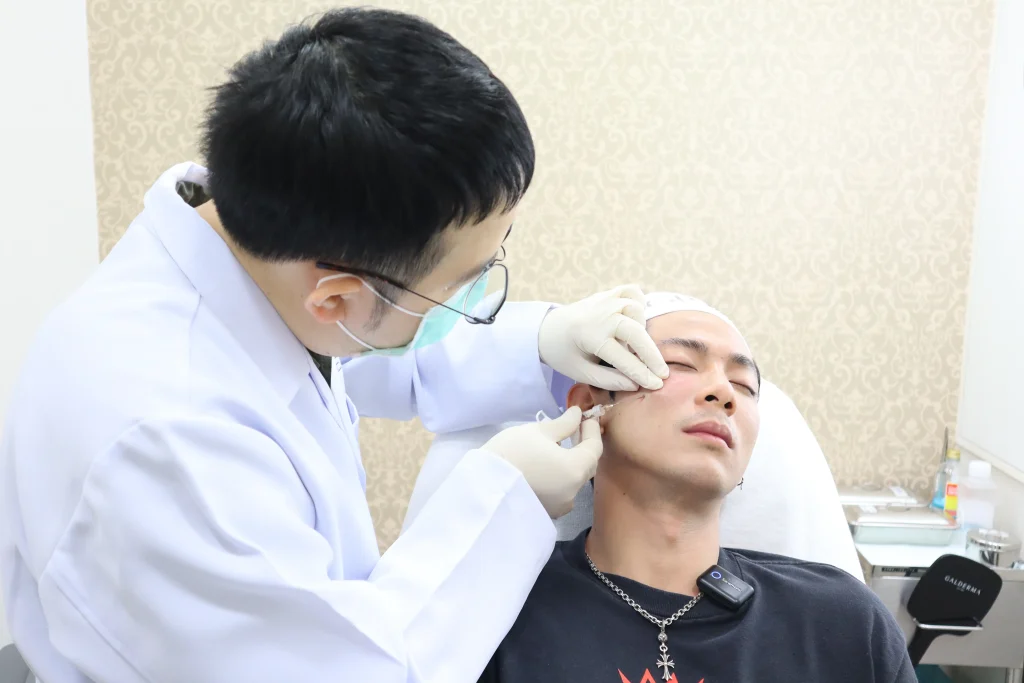
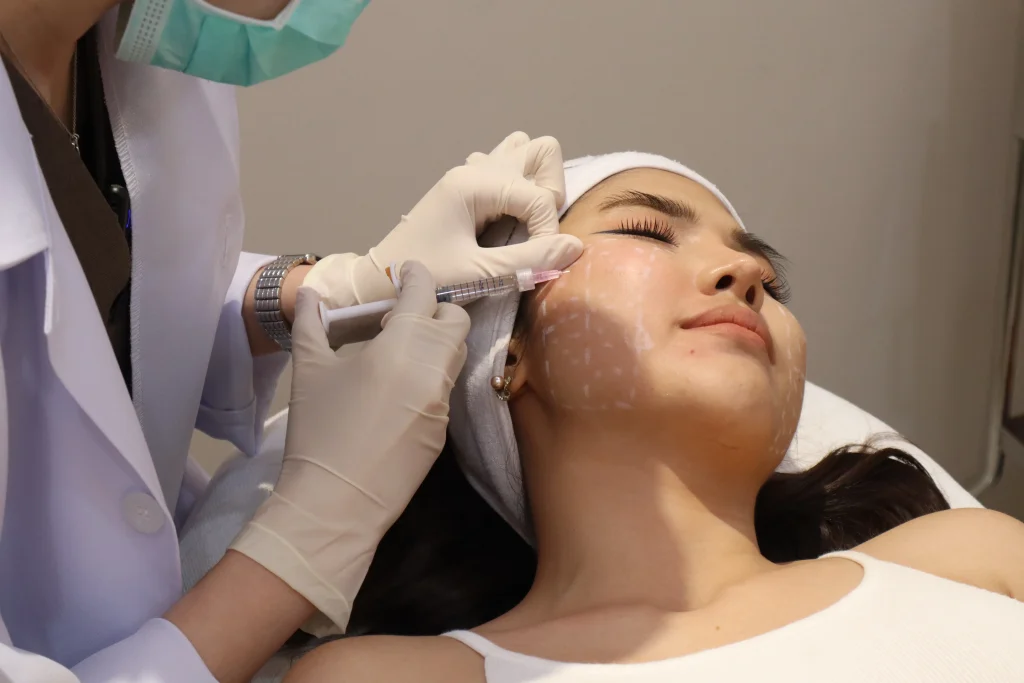
Dermal fillers work in an entirely different way. Rather than affecting muscle movement, fillers physically add volume beneath the skin — restoring structure, smoothing out static lines, or reshaping specific features.
Most fillers are made from Hyaluronic Acid (HA), a substance naturally found in the body that attracts and retains moisture. When injected, HA filler integrates with the surrounding tissue and adds visible volume immediately.
Fillers address static wrinkles and volume loss — changes that are visible even when the face is completely relaxed. Deep nasolabial folds, hollowed cheeks, flat lips, or under-eye hollows are all caused by volume loss, not muscle movement — which means Botox wouldn’t help, but filler would.
Key facts about fillers:
- Results are visible immediately after treatment
- Lasts 12–24 months depending on filler type and treatment area
- HA fillers can be dissolved with hyaluronidase if needed
- Minimal downtime; some swelling or bruising may occur for a few days
Botox vs Filler: Side-by-Side Comparison
| Botox | Dermal Filler | |
|---|---|---|
| How it works | Relaxes muscles | Adds volume beneath the skin |
| Target concern | Dynamic wrinkles (from expression) | Static wrinkles, volume loss, contouring |
| Results appear | 3–7 days | Immediately |
| Duration | 3–6 months | 12–24 months |
| Reversible? | Yes — wears off naturally | HA fillers: yes (with hyaluronidase) |
| Common areas | Forehead, crow’s feet, frown lines, jaw slimming | Cheeks, lips, nasolabial folds, under eyes, chin |
| Downtime | Minimal (hours) | Minimal (1–3 days) |
Which One Is Right for You?
The right treatment depends entirely on what kind of change you want to make and what’s causing the concern.
Choose Botox if you want to:
- Smooth forehead lines, crow’s feet, or frown lines
- Slim the jawline by relaxing masseter muscles
- Lift the corners of the mouth or eyebrows subtly
- Reduce excessive sweating (hyperhidrosis)
- Prevent new expression lines from forming
Choose Filler if you want to:
- Restore volume to cheeks or temples that have flattened with age
- Add definition or fullness to lips
- Reduce the appearance of deep smile lines (nasolabial folds)
- Fill hollows under the eyes
- Contour the chin or jawline
Not sure which applies to your concern? A simple rule of thumb: if the line or change appears only when you make an expression, Botox is likely the right approach. If it’s visible when your face is at rest, filler is probably more appropriate. In many cases, a doctor will recommend both for comprehensive results.
Can You Use Botox and Filler Together?
Yes — and this is actually a very common approach. Botox and fillers complement each other rather than compete.
A typical combined plan might involve Botox to address the upper face (forehead, around the eyes) where expression lines dominate, while filler addresses mid-face volume loss or lip definition. Together, the result is more comprehensive than either treatment alone.
The timing and sequencing depend on your individual goals — this is something your doctor will advise on during consultation. Generally, both can be done in the same appointment, though some doctors prefer to space them out.
Looking for Longer-Lasting Results? Sculptra Might Be Worth Considering
If you’ve been researching Botox vs filler but feel like neither quite addresses what you’re looking for — particularly if your concern involves overall facial structure, loss of firmness, or skin that looks tired regardless of expression — there’s a third option worth knowing about: Sculptra.
Unlike Botox or HA filler, Sculptra doesn’t relax muscles or add volume directly. Instead, it stimulates your body to produce its own collagen over time. The result builds gradually over 2–3 months and can last more than 2 years — significantly longer than either Botox or standard filler.
Sculptra tends to suit people who:
- Want long-term structural restoration rather than immediate volume
- Have noticed overall facial sagging or hollowness that filler alone doesn’t fully address
- Prefer gradual, natural-looking improvement over visible change right after treatment
- Are thinking about facial maintenance as a long-term plan
It’s not a replacement for Botox or filler — it works differently and solves a different problem. In many cases, doctors use all three together: Sculptra to restore the foundation, filler to address specific areas, and Botox to manage expression lines.
👉 Read more: What is Sculptra and how does it work?
Common Myths — Clarified
❌ “Botox will make me look frozen.”
✅ Only if too much is used, or it’s placed incorrectly. Proper dosing by an experienced doctor produces natural movement with softened lines — not a fixed expression.
❌ “Filler will make my face look puffy.”
✅ Over-filling is a real risk when too much product is used in the wrong areas. A conservative, anatomically informed approach produces balanced, natural-looking results.
❌ “Once you start, you have to keep going.”
✅ Neither treatment is physically addictive, and both wear off naturally. If you stop, your face returns to its previous state — it won’t become worse from having had the treatment.
❌“Fillers are permanent.”
✅ Standard HA fillers are not permanent. They are gradually broken down by the body over 12–24 months, and can be dissolved faster with hyaluronidase if needed.
What to Look for in a Clinic
Both Botox and filler are medical procedures. The quality of the outcome depends heavily on the injector’s skill, the products used, and the assessment process before treatment.
When evaluating a clinic, look for:
- Treatments performed by licensed doctors — not beauty therapists or unqualified staff
- Certified, authentic products — FDA-approved Botox brands (such as Allergan or Dysport) and reputable filler brands with verifiable lot numbers
- Thorough consultation — a doctor who assesses your facial anatomy before recommending a plan, rather than defaulting to a standard package
- Conservative approach — good injectors start with less and build gradually, rather than over-treating in a single session
Botox and Filler at La Grace Clinic
La Grace Clinic offers both Botox and dermal filler treatments performed by licensed aesthetic doctors across 8 branches in Bangkok. All products used are FDA-approved, with verifiable authenticity. Consultations include a full facial assessment before any treatment is recommended.
📞 087 494-4000, 087 494-9000 Line: @lagraceclinic
FAQ : Botox vs Filler
A: Most people describe it as a brief pinching sensation. The needles used are very fine, and the procedure takes only a few minutes. Numbing cream can be applied beforehand if needed.
A: Most HA fillers contain lidocaine (a local anaesthetic) within the formula, which makes the experience more comfortable as treatment progresses. Some areas — particularly lips — are more sensitive than others.
A: Initial softening appears within 3–5 days; full effect is visible at around 14 days.
A: HA fillers can be dissolved with an enzyme called hyaluronidase, which breaks down the filler within 24–48 hours. This is one of the key advantages of HA-based products over permanent or semi-permanent alternatives.
A: There’s no fixed age — it depends on your skin, genetics, and goals. Preventive Botox (treating lines before they deepen) is increasingly common from the mid-20s. Filler is typically more relevant from the late 20s onward as collagen and volume loss become more noticeable.
A: In many cases, yes. Your doctor will advise based on the areas being treated and the amount of product involved.
Summary : Botox vs Filler
Botox and dermal fillers solve different problems. Botox targets dynamic wrinkles caused by muscle movement — it works by relaxing those muscles rather than filling anything in. Fillers address volume loss and static lines — adding structure where the face has lost it with age. Understanding which applies to your concern is the first step to choosing the right treatment — and in many cases, a combination of both gives the most natural, balanced result.
Related Links